The AAP states that: "Parents are entitled to factually correct, nonbiased information about circumcision and should receive this information from clinicians before conception or early in pregnancy, which is when parents typically make circumcision decisions."
Yet, how much information are hospitals and doctors willing to give to parents?
Check out this pdf file from Kaiser Permanente: http://www.permanente.net/homepage/kaiser/pdf/3558.pdf
It starts with a very common lie: "Circumcision is the removal of the foreskin that covers the tip of the penis". Actually the foreskin is the tip of the penis, not an attachment, not a fashion accessory. There is no clear line of separation between the foreskin and the penis, and in fact there is no standard as to how much or exactly what tissues need to be removed. The foreskin does cover something, it covers the glans, as much as the lips of the mouth cover the inside of the mouth.
The listed risks of circumcision mentioned by the flyer are: infection, bleeding, pain, injury to the penis.
How severe are these risks? The flyer says these risks are small and "serious complications are very rare (1 in 500)". I wouldn't call a 1 in 500 rate to be very rare, when compared to 1.2 million newborns circumcised every year in the United States. That means 2,400 babies every year would experience serious complications.
What the flyer doesn't state is: bleeding and infections can become fatal. Injuries to the penis can last a lifetime. And exactly what kind of injuries we are talking of? Mild ones, as adhesions (that will be painful and traumatizing for parents), more complex injuries (such as meatal stenosis, fistulas, damage to the urethra, all of which will require additional surgeries to "repair"), to completely damaging injuries (loss of part or the whole glans, loss of the penis, loss of all the skin of the penis, too much skin removed which may result in pain and abrasions during sex in adult life...)
Then the flyer moves to mention the effect on men's sexual life, saying it "is not fully known. Some studies have reported equal sensation", but the untold part, implicit by the word "some", is that some other studies have indeed shown less sensation and decrease on sexual function. One of such studies, which should be enough for doctors to think it twice - and yet it has never been seriously considered by the AAP, is "Fine-touch pressure thresholds in the adult penis" (Sorrells et al, 2007), which states that "The glans of the circumcised penis is less sensitive to fine touch than the glans of the uncircumcised penis. The transitional region from the external to the internal prepuce is the most sensitive region of the uncircumcised penis and more sensitive than the most sensitive region of the circumcised penis. Circumcision ablates the most sensitive parts of the penis". A slightly similar study by Payne et al., didn't find a difference, but they never took measurements on the foreskin! In the words on one of the researchers, "[t]he foreskin's job is to cover the penis and protect it," she said. "Its job is not to be a part of the sensitivity." Talk about researcher's bias.
Then the flyer moves to the "benefits of circumcision", and the first one is of course "lowers the risk of cancer of the penis". But how much is the real risk of cancer of penis? Is it frequent? Does it really decrease? The AAP, in spite of touting this same benefit, has to come clean when showing numbers, by saying: "In fact, in men with an intact prepuce and no phimosis, there is a decreased risk of invasive penile cancer (OR: 0.5). When excluding phimosis, the risk disappears, which suggests that the benefit of circumcision is conferred by reducing the risk of phimosis and that the phimosis is responsible for the increased risk." (page 14 of the Technical Report), and again the untold part is that phimosis can often be treated without any excision of tissue, thus making circumcision unnecessary.
Not only that, but this benefit is not proportional to the complications that it would cause. The report again, states that:
"It is difficult to establish how many male circumcisions it would take to prevent a case of penile cancer, and at what cost economically and physically. One study with good evidence estimates that based on having to do 909 circumcisions to prevent 1 penile cancer event, 2 complications would be expected for every penile cancer event avoided.121 However, another study with fair evidence estimates that more than 322 000 newborn circumcisions are required to prevent 1 penile cancer event per year.122 This would translate into 644 complications per cancer event, by using the most favorable rate of complications, including rare but significant complications.123 The clinical value of the modest risk reduction from circumcision for a rare cancer is difficult to measure against the potential for complications from the procedure. In addition, these findings are likely to decrease with increasing rates of HPV vaccination in the United States."
So, 909 to 322,000 circumcisions to prevent a single occurrence of a cancer that takes place in old age, at the cost of 2 to 644 complications. Doesn't sound that great of a benefits, does it?
The second benefit is a lower risk of UTIs. Other sources (including the AAP) usually say "during the first year of life". Normally, what they don't say is that the risk is already lower in males than in females regardless of circumcision status, and that UTIs in females are treated with medicine. Not only that, but circumcised babies still get UTIs. So, does this justify the removal of erogenous tissue?
The third stated benefit is "May help prevent STDS such as HIV". Notice the words "May help". We all know that the United States has a high prevalence of HIV and other STDs, compared not only to Europe, but to Latin America, and yet most men in the United States are circumcised and most men in Europe and Latin America are not. So how has circumcision helped, really?
Fortunately, a paragraph later Kaiser states that these long-term benefits are small. It still does not addresses the fact that circumcision DOES NOT prevent STDs and safe sex practices should be encouraged.
Then they state "the decision to circumcise your baby is a personal choice". Intact-friendly circles strongly oppose this wording, because the personal choice of parents doesn't take into consideration the personal preference of the person undergoing the procedure. A circumcised baby becomes a forcefully circumcised man, whether he likes it or not, whether he feels it was beneficial or harmful. And in fact, if genital alteration surgery was a personal choice, female circumcision of babies (i.e. labiaplasty or clitoral unhooding) would also be a personal choice of the parents, but it isn't. In the United States, any non-therapeutic alteration of the genitals of a female minor (except in pregnancy and labor) is a federal crime regardless of the cultural or religious beliefs. We can argue that in both cases, (and not talking of the extreme cases of FGM such as infibulation, clitoridectomy, but of the mild forms, the one that consenting adults can get done at a plastic surgeon, labiaplasty and clitoral unhooding, or even the "ritual nick") male and female circumcision of minors both remove erogenous healthy tissue without the patient's consent. Even the AAP stated in 2010 (in a now retracted policy on "Ritual Genital Cutting of Female Minors") that "Some forms of FGC are less extensive than the newborn male circumcision commonly performed in the West". So if this is true, why is every form of FGC a crime while male circumcision is "personal choice" of the parents?
The flyer then states that "some parents talk about whether their son will look like his father or like other boys in the locker room". Both arguments are non-medical and simply fallacious. The boy won't ever look like his dad, nor like other boys in the locker room. Every circumcision looks different. Parents and sons don't often sit around comparing genitals, nor boys do. So this is a bullshit reason to appease the sense of conformity and impose a "social surgery" upon non-consenting individuals by brainwashing those who can sign the proxy consent.
The flyer continues: "The American Academy of Pediatrics does not recommend circumcision as a routine procedure" - this is true, and yet people are severely confused about it, thanks to the so touted "benefits outweigh the risks" mantra that the media so gladly parroted on August 27th of 2012.
In deciding, the flyer says: "You may want to talk with your partner, family, or firends to help you decide. Consider your cultural and/or religious values." - Are there any other excising surgeries that are done for cultural or religious reasons? Is this medicine or religion? Is it ethical to permanently and irreversibly remove part of a person's body for cultural or religious reasons without that person's consent?
The flyer then says: "Making a decision about circumcision is more difficult after delivery, when you may be very tired". Not only tired, but by then the mother may feel protective of the baby and won't want to hand him for a surgery that is painful. But let's not talk about that, right Kaiser?
The "How is circumcision done" portion of the flyer is what triggered me to dissect it.
The first phrase: "Infants must be stable and healthy to be circumcised in the hospital", unfortunately is contradicted in the real world, where premature babies and babies straight out of the NICU are often circumcised, contradicting general medical practices. In March of 2013 I was aware of a case where a baby in California who had shown to have clotting issues (the pinpricks didn't heal properly), and yet he was circumcised; the baby died two days later, after suffering major loss of blood and seizures, yet the doctors attributed it to an existing bacteria or condition. The non-healing pinpricks should have been enough to suspect that the baby was not in good conditions to undergo an excision.
The flyer says that a shot of pain medicine or an anesthetic cream is used, in addition to a sucrose pacifier, for pain relief. Anesthetic creams don't stop the severe pain of cutting a densely innervated part of the body. Shots of anesthetic are painful themselves, but are more effective. Sucrose pacifier at most keeps the baby partially distracted (or trying not to choke!).
The flyer then says that your baby may have some mild pain during and after the surgery, which usually does not last more than a day. This is contradicted and you can find reports in social media of babies in severe pain every time the diaper is changed for a week or so. Parents are often unprepared for the pain that their babies will experience.
The flyer then describes the plastibell method as follows:
* A plastic ring is tied around the end of the penis
* The foreskin is removed
* The plastic ring stays on the end of the penis and prevents bleeding after the surgery.
This is highly imprecise. A more realistic description would be:
* The glans and the penis are forcefully separated with a blunt probe.
* A dorsal incision is cut on the foreskin with scissors for easy insertion of the ring.
* The ring is inserted over the glans and tied with a string to cut off circulation to the foreskin (to necrotize the tissue)
* The foreskin may or may not be cut off with a scalpel at that point. The ring keeps the outer and inner layers of the foreskin joined for healing and keeps circulation from the foreskin so it dries and falls off.
Then they describe Gomco and Mogen methods: "The foreskin is removed from the penis using the Gomco or Mogen devices" [clamps! that's what they are]
The Gomco clamp is a slow procedure that forcefully crushes the foreskin between two metal parts, cutting circulation to the foreskin and allowing cutting it with scalpel. A previous dorsal slit is usually done to facilitate insertion of the metal bell used to protect the glans.
The Mogen clamp crushes the foreskin without protecting the glans and allows quick cutting with a scalpel. While generally faster (and probably less painful), it has an added risk of injury because the glans is not protected and may get between the clamp and be amputated.
There is a section on "care of the uncircumcised penis".
It says: "After 1 to 2 years of age, you can retract the foreskin partially for cleaning". This is WRONG and PAINFUL. At that age, the glans and the foreskin are likely to still be attached through the balanopreputial synnechia, and retracting it, even partially, may hurt it, may cause bleeding and scarring and acquired phimosis. In fact, it may make circumcision necessary.
"When your child is 5 or 6 years old, teach him to do this himself when he takes a shower". This may be too soon! The percent of boys capable of retracting the foreskin at 5 years is approximately 40%.
"Many times the foreskin cannot be fully retracted until your child is a teenager; this is not a reason to worry." This is true. Over 90% of the boys become capable of retracting by the time they are 17. Those who can't retract at that age may need to do stretching exercises.
What they also fail to mention is that using soap inside the foreskin can cause irritations. Generally retracting the foreskin (by the person only, and only when he becomes able to do it), rising the glans with warm water, and replacing the foreskin, is all the care that needs to be taken for proper hygiene. The AAP gets this wrong as well.
The flyer does not have a single word about self determination and how circumcising a minor based on parental consent is ethically troublesome, as it is an invasive intervention that is not essential to the baby's well being. In general the American medical establishment is strongly intent on denying that newborn circumcision violates the bodily integrity and right of self-determination of the person the baby will become, which is perhaps the most important question that parents should ask themselves before making an irreversible decision.
Thursday, June 27, 2013

Wednesday, May 29, 2013
Boy (3 years old?) suffers partial amputation of the glans during circumcision in Morocco
A boy loses 20% of his glans during a circumcision. The boy cries in horrible pain.
This video may have been posted by the parents, who wrote:
l'assassin est docteur BOUHDI FOUAD Bd Fida à casablanca et le complice Docteur FAYSSAL LAZRAK de clinique ATFAL Oasis à casa: le premier a causé la coupure pendant la circonciosion et a mis des sutures en fermant carrément le canal d'urtine et le 2ème a refusé de délivrer le compte rendu avant et après opération qu'il a effectué sur mon enfant pour sauver le fonctionnement d'urine
(the murderer is Dr. Fouad BOUHDI Bd Fida in Casablanca and the accomplice Doctor FAYSSAL LAZRAK clinical Atfal Oasis casa: the first caused the break for the circumcision and put sutures closing outright the urinary channel and a second refused to issue a report before and after the operation he performed on my child to allow urination)
The video was posted May 18th, 2013.
From the description, the procedure was performed at Clinique Atfal, in Casablanca, Morocco. http://www.blanee.com/etablissements/clinique-atfal-Casablanca
Partial and total amputation of the glans is one of the "low incidence high severity" complications of circumcision, one which leaves life long complications. EVERY CIRCUMCISION exposes the child to this risk, even if with a low incidence.
Not only is the boy traumatized, but he may have problems with urination and sex for the rest of his life.
My heart breaks for this boy.
More information (Arabic): http://hespress.com/societe/79020.html
More documented severe complications of circumcision: http://circleaks.org/index.php?title=Documented_Severe_Complications_of_Circumcision
Tuesday, May 28, 2013
Rick Steves pays for a circumcision for his show
Rick Steves says:
"If ever you’re making a TV show about village and traditional culture in Turkey, be sure to arrange to film a circumcision. For a few hundred dollars you can hire the band, the doctor, and the horse, and pay for all the pizzas and soft drinks. We even paid for the boy’s prince outfit. From a TV production point of view, it was a marvelous value. And the most beautiful moment for me was the heartfelt thanks the dad gave me as we left. I promised we’d send him a copy of the show as soon as it was finished."
The photos say:
"Before meeting the doctor, the young man of the hour was having a wonderful time. [..]" (of course there are no words about AFTER meeting the doctor)
"A good circumcision comes with a decorated horse and a three-piece band. The extended family, and anyone who hears the commotion and wants to drop by, is welcome. It’s a grand festival."
"We left the family and doctor alone in the home, put the camera down, and joined the party outside. The doctor said things went just fine…but we never saw the boy again."

How would you feel if he was documenting a female circumcision in Africa, Malaysia or Indonesia?
Monday, May 13, 2013
The Vatican tolerates stem cell research from Genital Mutilation
From: The Stem Cell Research and Cloning Controversy
Issue: 40 Page No: 18 Updated: 12/27/2010 10:00 AM
Author: John M. Swomley, Professor Emeritus of Social Ethics
Topics: Cloning
Type: Article
The present controversy over stem cell research and cloning has occurred because Pope John Paul II has decreed that human life begins at conception instead of the biblical view that human life begins at birth. This is the basis for opposition to various forms of contraceptives, to abortion, and to stem cell research.
However, the Vatican does not object to stem cells derived from miscarried embryos or from umbilical cords. It also does not object to skin stem cells derived from the foreskins after circumcision.
***
Dear people of the Vatican,
Foreskins used for research were cut off from babies who did not consent and who may not agree in the future with a) their foreskin being cut off, and b) their foreskin being used for research.
Circumcision of minors is ethically contentious. Benefits from stolen goods are immoral benefits. You, of all the institutions, should not condone non-therapeutic genital cutting of minors, and the industrial/commercial/academic use of the tissues removed.


Saturday, May 11, 2013
Circumcision at 5 years: how your doctor gets to lie and collect a check
One of the supposed benefits of circumcision is the "prevention of phimosis". It is true that phimosis is a condition of the foreskin which may require circumcision, but circumcising babies to prevent circumcision is what I call "prevention by obliteration": any part of the body that is removed won't develop any condition or pathology - but won't serve any functions to the body anymore.
Phimosis occurs when the foreskin cannot retract behind the glans. This condition will make hygiene and sex more complicated, some times even making penetrative sex impossible. Severe cases of phimosis may require circumcision. Milder cases may respond to steroid creams, stretching exercises and stretching devices.
The big confusion however is that there are two different kinds of phimosis:
- physiological phimosis, which is normal and generally resolves itself in time; and
- pathological phimosis, which requires some treatment.
Let's look deeper into this. At birth, the foreskin and the glans are usually sealed by the "balanopreputial membrane". This is absolutely normal - this is physiological phimosis. This membrane prevents the foreskin from retracting. Parents of an uncircumcised child do not need to retract his foreskin to wash the penis, and in fact, retracting the foreskin would be painful and harmful.
As the child grows, this membrane desquamates to allow retraction. This can occur in months - or in many years. We will look more into this shortly.
If after puberty, the child cannot retract the foreskin, then we may have a case of pathological phimosis. This often occurs because a ring of skin on the foreskin will not expand enough to allow the glans to glide through. While some men may go their lives without ever retracting their foreskins, some will simply have issues because of this and won't be able to have normal sexual lives. Phimosis during adulthood is also a risk factor for penile cancer. So it's better to try to resolve phimosis after puberty.
One important variable here is the age of retraction. A 1999 study by Cold and Taylor shows a graphic of the age of retraction - referring a 1968 study by Jakob Øster. It shows that at 6 to 7 years, approximately 60% of the boys still present adhesions (in other words, they cannot retract the foreskin yet). At 10-11 years, close to 50% of the boys still present adhesions. At 14-15, approximately only 10% of the boys still present adhesions. As we approach 17 years, only a very small percentage will still present adhesions. That means that, left uncircumcised, most boys will be able to retract their foreskin before they are 17 years old.
 |
| Incidence of preputial adhesions in various age groups, after Øster |
As you can see, there are a lot of details in understanding what is phimosis and when phimosis becomes a problem. But hospitals and doctors often use the ignorance of parents to their benefit, by turning a natural condition into a pathological one.
I often hear parents who during childhood "had to" circumcise the child that they tried to keep intact, because he "had phimosis", the son was traumatized, and discouraged they have decided that any future son will be circumcised at birth.
This, however, is the result of a lie.
The other day, as I was reviewing the website of the Cincinnati Children's Hospital, base of some of the researchers in the trial of Gomco vs. Mogen clamp, I ran into an interesting information.
First, I have to admit that their page on circumcision provides some more information than most other clinics do. For example, this page dedicates one paragraph to the role of the foreskin. While this paragraph is very incomplete (it does not explain at all the sexual function of the foreskin), at least it says that the foreskin "protects the sensitivity of the glans".
On their section on benefits they also admit that the risks of UTIs, phimosis, balanitis and penile cancer are all low. Very low. And they don't even try to talk about prevention of STDs. I'm honestly surprised, this page seems more honest than most other hospitals.
However, I also found a referral guide, and this is their guide for circumcision:
Elective circumcisions (outside the newborn period) are performed around 6 to 12 months of age. Therefore we recommend evaluation at age 6 months.
Neonates who were circumcised at birth should be seen seven to 10 days later in the primary care physician's office. At this visit, the infant should be checked for the development of adhesions between the glans and the foreskin. These adhesions should he lysed in the office at that time. Children with adhesions that cannot be lysed in the office, or with a sub-optimal initial circumcision, may be seen at age 6 to 12 months for possible surgical revision.
Children who are uncircumcised should not have their foreskin retracted until 3 to 4 years of age. If adhesions still exist when the child is 5 years old, offer the option of circumcision or recommend waiting until puberty to see if the adhesions resolve spontaneously.
This is the key part: "If adhesions still exist when the child is 5 years old, offer the option of circumcision or recommend waiting until puberty to see if the adhesions resolve spontaneously." From the graphic, over 65% of the children at age 5 still present adhesions! That means that 65% of the uncircumcised children are at risk of being referred for circumcision at age 5 unless their parents have enough understanding to know that this is not a pathological condition.
Let's be clear. Diagnosing phimosis on a child is almost always fraud. Retracting the foreskin of a 5 year old child is unnecessary and potentially dangerous, as it can cause pain, bleeding, wounds inside the foreskin, infections and additional adhesions (as wounds inside the foreskin due to forceful retraction may become scar tissue binding the glans to the foreskin!).
Now you know how they do it.
And since we are going at it now, is the AAP Policy on Circumcision any better?
The 9th page of the Technical Report states that:
Parents of newborn boys should be
instructed in the care of the penis
at the time of discharge from the
newborn hospital stay, regardless of
whether they choose circumcision or
not. The circumcised penis should be
washed gently without any aggressive
pulling back of the skin.24 The noncircumcised
penis should be washed
with soap and water. Most adhesions
present at birth spontaneously resolve
by age 2 to 4 months, and the
foreskin should not be forcibly retracted.
When these adhesions disappear
physiologically (which occurs
at an individual pace), the foreskin
can be easily retracted, and the
whole penis washed with soap and
water.
There are several things wrong with this. The use of soap, particularly antibacterial, scented and stronger soaps, on the foreskin and penis in general, may disrupt the pH of the foreskin and damage the beneficial bacteria, causing irritation and infections. It is actually recommended to use just warm water to rinse the penis.
The parents of the child DO NOT need to retract the foreskin at any age. Only the child himself should retract the foreskin, and that only when he becomes able to do it comfortably.
Now, I'm especially concerned with this: "Most adhesions ... spontaneously resolve by age 2 to 4 months". This is definitively not supported by the graphic by Cold and Taylor. It's only at 17 years of age that most males will resolve their adhesions. This sentence regarding 2 to 4 months will make many people wrongfully think that the inability to retract a child's foreskin is a pathological condition that merits immediate surgical intervention.
In one occasion someone argued that this document is written for health professionals, not for the typical parents. It is my opinion that even if it is written for health professionals, it should provide more information as this is the one chance to educate them.
So now you know how your doctor gets to lie to you, injure your son and collect a check.
Gentle Touch Circumcision, Dr. Green, how circumcision promoters work
 |
| Dr. Stephanie Green |
What strikes me as funny, in other words fishy, is that in the pages about the Pros and Cons of circumcision, there is no mention whatsoever about the position of the College of Physicians & Surgeons of British Columbia (CPSBC). There is, however, mention of the American Academy of Pediatrics, followed by a mention of the current position of the Canadian Pediatric Society (CPS), which is likely to change in the short term.
Why is it important to overlook the position of the CPSBC?
Could it be because it has recommendations such as "Advise parents that the current medical consensus is that routine infant male circumcision is not a recommended procedure; it is non-therapeutic and has no medical prophylactic basis; it is a cosmetic surgical procedure; current evidence indicates that previously-thought prophylactic public health benefits do not out-weigh the potential risks", "Provide objective medical information about the risk of complications and potential harm in infant male circumcision" and "Discuss the new ethical considerations of infants’rights and proxy consent in a nontherapeutic procedure"?
Could it be because it's better to parrot the AAP's mantram that "the benefits outweigh the risks"?
And since they take the time to reference the AAP while ignoring a Canadian institution, why stop there? Why not quote the Royal Dutch Medical Associaton (KNMG), which states that "Non-therapeutic circumcision of male minors is contrary to the rule that minors may only be exposed to medical treatments if illness or abnormalities are present, or if it can be convincingly demonstrated that the medical intervention is in the interest of the child, as in the case of vaccinations" and "Non-therapeutic circumcision of male minors conflicts with the child’s right to autonomy and physical integrity."
Perhaps because those institutions do not support the benefits touted by Dr. Green?
What about some numbers referred by Dr. Green that would be extremely difficult to prove at all? Let's see:
Dr. Green states, without a reference, that "Between 1954 and 1989, fifty million circumcisions were performed in the USA. Three deaths were reported due to circumcision. Two babies had bleeding disorders and one was a premature infant weighing only 1.9kg.". In reality, many more deaths in the United States (and Canada) have been linked to circumcision, and the American Academy of Family Physicians estimates one death in 500,000 procedures - which would represent 2 or 3 deaths per year in the United States. Other sources estimate higher mortality.
Dr. Green repeats the 60% risk reduction of contracting HIV, without mentioning that this only applies to heterosexual transmission and under the specific conditions of Africa. This number is the result of Randomized Controlled Trials (RCTs) executed in Africa, and cannot be directly extrapolated to a different population, as the possibilities of transmission and the risk/benefit estimations will immediately change. Dr. Green does not mention that this risk reduction does not apply to males who have sex with males (MSM), does not protect females from a circumcised infected male, and does not apply to non-sexual transmission of HIV. And of course she does not mention that the RCTs have been challenged by other health professionals due to methodological issues.
Dr. Green states that circumcision "Eliminates Phimosis". This is what I call "prevention by obliteration". Any organ removed from the body can no longer develop pathological conditions. However any organ removed from the body also ceases to provide its functions. In that sense, preventing phimosis by circumcision is not proportional, especially when most men will not develop phimosis, and those who do develop it may be able to overcome it with different and much less invasive treatments.
Dr. Green indicates without any explanation that circumcision makes "Easier hygiene". This is the worst fallacy of circumcision. Hygiene of an intact penis is extremely simple. In a child: leave it alone; rinse the outside as if it was a finger. Never pull the foreskin back. In a person who can retract the foreskin (generally, teenagers or adults): retract, rinse, replace. Takes less than 10 seconds. Avoid soaps to avoid disrupting the beneficial bacteria of the foreskin and the delicate pH. Soap residues and strong antibacterial soaps can cause irritations and infections of the foreskin. - Are there any other body parts that physicians recommend cutting off so you don't have to wash them?
Dr. Green repeats another one of the bigger lies of circumcision, that circumcision "Virtually eliminates risk of cancer of the penis". First, the risk of cancer of the penis is in itself extremely low (even the AAP said so on page 14 of their Technical Report: "The clinical value of the modest risk reduction from circumcision for a rare cancer is difficult to measure against the potential for complications from the procedure. In addition, these findings are likely to decrease with increasing rates of HPV vaccination in the United States" based on the estimation that in order to prevent a single event of penile cancer, 909 to 322,000 babies would have to be circumcised and there would be 2 to 644 complications - in other words, it's not proportional). Second, once phimosis is considered, the presence or absence of foreskin does not increase the risk of penile cancer; it's only in cases of adults with phimosis that there is a higher risk, and those individiuals can get treated for their condition. Third, a better preventive measure is to avoid promiscuity and practice safe sex to reduce the risk of contracting HPV. And finally, penile cancer can occur in circumcised men, and in fact there are documented cases where penile cancer occurred on the site of the circumcision scar!
Dr. Green says that "Some studies suggest less sexual dysfunction later in life" - however, some other studies suggest the opposite, that circumcised men have 4.5 more chances of developing erectile dysfunction. A 2011 study in Denmark showed that "Circumcision was associated with frequent orgasm difficulties in Danish men and with a range of frequent sexual difficulties in women, notably orgasm difficulties, dyspareunia and a sense of incomplete sexual needs fulfilment"
Dr. Green states that "some estimate between 6% and 10% of boys will require circumcision in their lifetime due to medical reasons". However, in 1980 Edward Wallerstein documented that in Finland, where Routine Infant Circumcision is not practiced, approximately 1 in 16,667 men requires adult circumcision for medical reason. A far number from the 6% to 10% that Doctor Green mentions, which begs the question what is so defective about North American penises.
Dr. Green states that "The overall risk of complication from this procedure is between 0.2% (2/1000) and 0.6% (6/1000)." This would be a tough number to prove. In fact, the AAP in their technical report on circumcision states that "The true incidence of complications after newborn circumcision is unknown, in part due to differing definitions of “complication” and differing standards for determining the timing of when a complication has occurred (ie, early or late). Adding to the confusion is the comingling of “early” complications, such as bleeding or infection, with “late” complications such as adhesions and meatal stenosis."
In the Research page, Dr. Green references the article "A 'snip' in time: what is the best age to circumcise?". I leave the reader the task of checking the authors in our circleaks wiki: Brian J Morris, Jake H Waskett, Joya Banerjee, Richard G Wamai, Aaron AR Tobian, Ronald H Gray, Stefan A Bailis, Robert C Bailey, Jeffrey D Klausner, Robin J Willcourt, Daniel T Halperin, Thomas E Wiswell and Adrian Mindel
Dr. Green final reference is what she affectionately calls "The Male Circumcumcision Guide for Doctors, Parents, Adults and Teens" - circnet, the page of Brian J. Morris. It is important to know that Brian Morris is not a medical doctor, he is a molecular biologist who has publicly stated that he would like to see circumcision become compulsory - so he is hardly an unbiased researcher. He is also associated with circlist, a group known for exchanging not only medical expertise, but also erotic content known as circumfetish.
Reviewing her consent form, I noticed that she omitted several important risks, such as concealed penis, meatal stenosis, development of skin bridges, skin tags, dispareunia (pain during sex), damage to the dorsal nerve (which can leave a man sexually insensitive), damage to the frenulum, long term damage to the glans due to keratinization (this always occurs)...
After reading this, would anyone still believe that her website contains complete and unbiased information about circumcision?
Thursday, May 9, 2013
Call to Action: Clinical trial of Mogen vs Gomco circumcision clamps at the Good Samaritan Hospital in Cincinnati, Ohio
The TriHealth Good Samaritan Hospital in Cincinnati, Ohio, is currently running a clinical trial to find which is better, whether the mogen clamp or the gomco clamp, to perform newborn male circumcisions.
 |
| Bottom-left: Mogen clamp. Top-right: Gomco clamp |
The purpose of this study is to compare two commonly used circumcision clamps (Gomco and Mogen) to see which results in less neonatal pain. Neonatal pain will be assessed by change in salivary cortisol level pre and post procedure. Secondary to that they will study which one causes more bleeding, requires more time, which one is followed by most parental satisfaction (what about the satisfaction of the adult that the baby will become?) on a follow up visit, which one causes more need for revisions (including recircumcisions) within 6 weeks, and which one is more likely to cause infections.
Bleeding is measured by weight of blood soaked gauzes after the procedure.
 |
| Mogen Clamp |
 |
| Gomco Clamp |
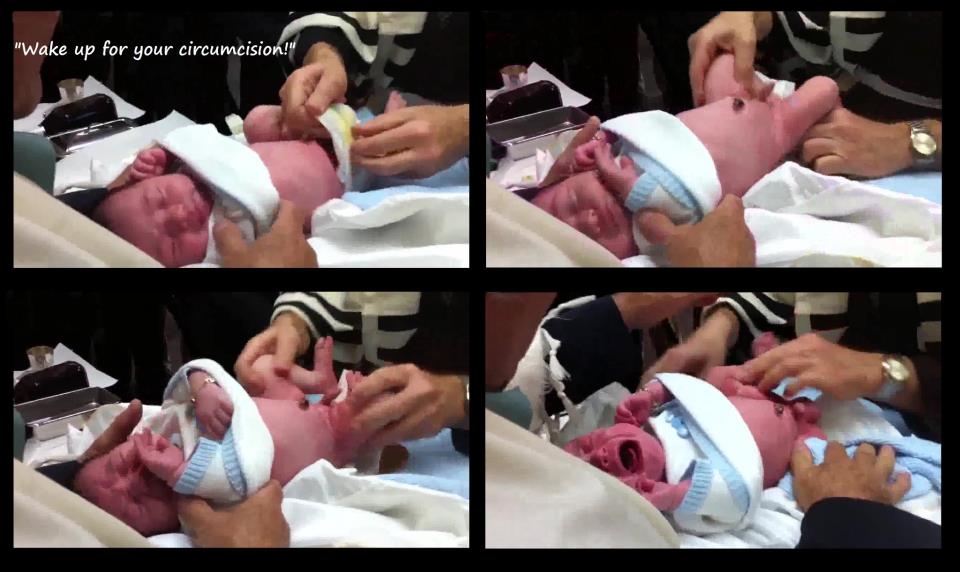 |
| Evolution of the facial expressions of a baby during circumcision |
They are starting from the hypothesis that the Mogen technique of circumcision is less painful, faster, and associated with less bleeding for newborns when compared to the Gomco technique after a resident circumcision standard teaching curriculum.
The participants are euphemistically called "volunteers", and they should be male babies 4 days or less, born healthy from pregnancies without complications.
Now, what could be wrong with this?
Let's start with the obvious. They are not pretending that the procedure is painless. They know that the procedure hurts, and that's what they want to compare.
The action of inflicting severe pain on someone is called torture. They are torturing babies. But then of course, every forced circumcision of a minor is torture.
Now, in order to do this they obtain consent from the parents. But parents are often unaware of how much pain a circumcision really causes until they see a video of the procedure. I would have to wonder how much information the parents obtain prior to consenting to the study.
In this video, you can hear the dad freaking out as the baby starts crying. The doctor says the baby is "excited".
Calling the baby a "volunteer" is such a horrible stretch. With the Gomco clamp I'm very sure they have to use a circumstraint, a board with Velcro straps to hold the baby still while they perform the procedure. Volunteers normally don't have to be forcefully restrained. In fact, I know of a lawsuit in the 1980s that successfully charged that the baby was falsely imprisoned due to the use of restraints. Most health professionals are aware that forcefully restraining an adult has legal and ethical implications, but why is it that they don't seem to have the same consideration to minors?
 |
| Baby strapped on a circumstraint |
 |
| 1984 NOCIRC newsletter detailing lawsuit including charges for battery and false imprisonment. |
But not only do they know that the procedure is painful, they are also aware that there are risks and complications, and they DO expect to see those risks (infections and bleeding being the most common) and complications (including adhesions although they didn't mention them, and the need to repairs and recircumcisions). In other words, they are running a medical experiment on human babies, knowing that those babies are going to suffer pain and that some are going to need additional surgeries or may suffer even more severe complications.
 |
| Skin bridge (adhesion) on a circumcised penis, a common complication that can cause pain during sex |
Well, for one, the mogen clamp is far from having a clean record. The "Manual for early infant male circumcision under local anaesthesia" published by the World Health organization in 2010 details that both the mogen clamp and the gomco clamp have an increased risk for penile laceration and amputation, but extends to say that "penile amputation can occur even under ideal circumstances" with the mogen clamp.
http://apps.who.int/iris/bitstream/10665/44478/1/9789241500753_eng.pdf

Now, has this ever happened? Yes, it happened in Israel in June of 2012 to a Muslim baby. It also happened in Illinois in February of 2007 in a medical circumcision, and also in Florida in 2004 in a Jewish circumcision (the mohel, Daniel Krimsky, tried to conceal the error causing loss of time and damage to the tissue, which failed to reattach). The same year it also happened to a baby circumcised by doctor Haiba Sonyika, who also failed to react timely, resulting in significant injury and iatrogenic hypospadias (in other words, the baby urinates through a new hole misplaced because of surgical mishap) and will require counseling and surgeries along his life. And it also happened in 2003 in L.A.
In 2004, Dan Savage, known columnist, received a letter from a man who suffered exactly this kind of injury:
I am 24 years old and lost my entire glans penis, the head of my dick, in a botched circumcision. Basically I have a shaft but there's no head at the end. Unfortunately, I was left with my balls so I still have a sex drive, but it's nearly impossible for me to climax. When I was much younger, around 14 to 16, I could sometimes masturbate to a climax, but after a couple of years I stopped being able to do this. Some of the women I've been with never saw the condition of my penis, and failed to notice when I didn't come. Others have seen my condition before intercourse and refused to have sex with me, while still others found out afterwards, after I wasn't able to come, and then never wanted to have sex with me again. Of course I never dare to ask anyone to suck me, although this might provide the necessary extra stimulation and actually help me climax.
So my problem, Dan, is twofold: I can't come and I can't get anyone to stick around and help me try to come. Can you suggest any special techniques for someone in my condition? Any help would be appreciated. I'm very miserable, frustrated, and lonely.
Mutilated and Comeless
 |
| Partial glans amputation, a complication of the Mogen clamp - photo from circumcisionharm.org |
 |
| Glans laceration caused by clamp - photo from circumcisionharm.org |
http://www.circleaks.org/index.php?title=Documented_Severe_Complications_of_Circumcision
In fact, these cases have been so common and so catastrophic that Mogen Circumcision Instruments Company went out of business in 2010 after paying several millionaire lawsuits. The clamps however were not recalled.
http://www.circleaks.org/index.php?title=Mogen
http://www.jacksonwhitelaw.com/az-personal-injury/2012/03/21/the-controversy-behind-the-mogen-clamp/
Not only were the clamps not recalled, but they are still in use, being favored by the often mentioned Dr. Neil Pollock in Canada (also a mohel), and recently received favorable reviews in a 2012 paper about the safety of over 1,200 infant male circumcisions in Kenya (in which there was one adverse event involving partial amputation of the glans)
Young, MR, Bailey RC, Odoyo-June E. Irwin TE, Obiero W, et al (2012). Safety of over twelve hundred infant male circumcisions using the Mogen clamp in Kenya. PLoS ONE 7(10): e47395, doi: 10.1371/journal.pone.0047395
http://www.readcube.com/articles/10.1371/journal.pone.0047395
In a 2013 study by Rebecca Plank in Botswana, the mogen clamp and the plastibell were compared. The adverse events with the mogen clamp were considered to be more frequent but "minor" (removal of too little skin and development of skin bridges and adhesions). Bleeding was more frequent with the mogen clamp as well.
Plank RM et al. A randomized trial of Mogen clamp versus Plastibell for neonatal circumcision in Botswana. J Acquir Immune Defic Syndr, online edition, DOI: 10.1097/QAI.0b013e318285d449, 2013.
http://www.aidsmap.com/Neonatal-male-circumcision-feasible-in-resource-limited-settings-Mogen-clamp-may-have-advantages/page/2566263/
Data from Attorneys for the Rights of the Child, ARCLaw, show over 80 million dollars paid on settlements over botched circumcisions since 1985. Beyond the economic value (when compared to a billion dollars a year industry), those numbers represent children whose lives were impacted for ever due to an elective surgery.
So, what the big picture tells us is that what these researchers at TriHealth Good Samaritan Hospital in Cincinnati, Ohio, are doing, is an experiment on human, American babies, which knowingly causes pain, without any existing condition or disease removes normal healthy and functional erogenous tissue from non-consenting "volunteers" (with no regard for the future preference of the adults they will become), subjects healthy individuals to amputative surgery, and risks causing iatrogenic harm to those babies, practicing a XIX century "elective" surgery (which again, they did not elect) with obsolete and dangerous equipment.
 |
| Mechanical function of the foreskin during sexual activity - a pleasure denied to circumcised men |
 |
| Comparison of an intact penis with its frenulum, and a circumcised penis missing the frenulum and with keratinized glans |
Personally, it bothers me that the 3 listed researchers are females. I wonder if I'm the only one who sees something wrong in 3 female researchers looking for the best way to slice and skin babies penises. In a way they are doing to babies almost the same thing that Lorena Bobbitt did to her husband, except that they are doing it protected under medical license and with the subterfuge of research.
I'm reminded of a 1959 American researcher, W. G. Rathmann MD, who invented a clamp for female circumcision, as a cure for frigidity. At least he wasn't targeting infants.
 |
| Rathmann Clamp for female circumcision |
 |
| Rathmann clamp in action - clamping the clitoral hood, the female equivalent of the male foreskin |
Promoters of female circumcision were in the wrong side of history, and so are promoters and researchers of infant male circumcision. The fact that it is an unnecessary operation, that it has risks and causes pain, that it provokes sexual changes, and that it is performed on a healthy normal baby who does not have a disease or condition, should be reason enough to stop right now.
Perhaps it is time they run a clinical trial to compare the pain and risk of complications between circumcised babies and "uncircumcised" babies (intact babies). I dare you AAP.
"[I]t can no longer confidently assume that circumcising a healthy boy will be viewed by him later as beneficial. Increasingly, circumcised males are learning the functions of intact genitals, documenting the harm from circumcision and pursuing genital wholeness. They will undoubtedly increase their pressure on circumcising societies to affirm male genital integrity and to prevent involuntary nontherapeutic circumcision."
Hammond, T. (1999), A preliminary poll of men circumcised in infancy or childhood. BJU International, 83: 85–92. doi: 10.1046/j.1464-410x.1999.0830s1085.x
http://www.noharmm.org/bju.htm
Information on the trial:
http://apps.who.int/trialsearch/trial.aspx?TrialID=NCT01726036http://clinicaltrials.gov/show/NCT01726036

http://www.cincinnatichildrens.org/bio/h/mounira-habli/
mounira_habli@trihealth.com

http://www.linkedin.com/in/michaelaeschenbacher
michaela_eschenbacher@trihealth.com
 Contact: Rachel Sinkey, MD
http://www.trihealth.com/discover-trihealth/education/trihealth-obstetrics-and-gynecology-residency/list-of-current-residents/
rachel_sinkey@trihealth.com
Sponsors and Collaborators
TriHealth Inc.
Please refer to this study by its ClinicalTrials.gov identifier: NCT01726036
A list of ongoing clinical trials on circumcision: http://www.nhs.uk/Conditions/Circumcision/Pages/clinical-trial.aspx
 |
| Van and Benjamin Lewis, 1970, Tallahassee Florida |
PS, while we are at it, this page: http://www.cincinnatichildrens.org/health/m/male-anatomy/ states that "Other boys are not circumcised and may have skin that covers the tip of the penis. If circumcision is not done the skin must be pulled back for proper cleaning" --- The problem with this is that it does not specify any age. The foreskin at birth is sealed to the glans, and it CANNOT be retracted. Retracting the foreskin of a child who has not yet separated can result in pain, bleeding, infection and development of adhesions. In turn, this can result in scar tissue that will become acquired phimosis and MAY require circumcision. See how bad this advice is?
Please let these guys know that they need to be clear. Nobody needs to retract a child's foreskin. Cleaning inside the foreskin can wait until the child becomes retractable (which may take until puberty - 17 years is not an uncommon age to become retractable) and should only be done by the child himself, not by the parents. It is not advisable to use soap in cleaning inside the foreskin as this can cause irritations and infections. Retract, rinse and replace, that's all it takes to wash the penis of a male who can already retract.
It is fair to acknowledge that on this other page: http://www.cincinnatichildrens.org/health/u/uncircumcised/ they provide better advice regarding age of retraction. But they still recommend soap, and this is a common reason why many "uncircumcised" males complain of irritation and infection. Soap disrupts the delicate pH and bacterial environment of the foreskin and may cause irritations. Soap, if used, should be mild, unscented, and rinsed completely. Better yet, just use warm water.
Subscribe to:
Posts (Atom)